
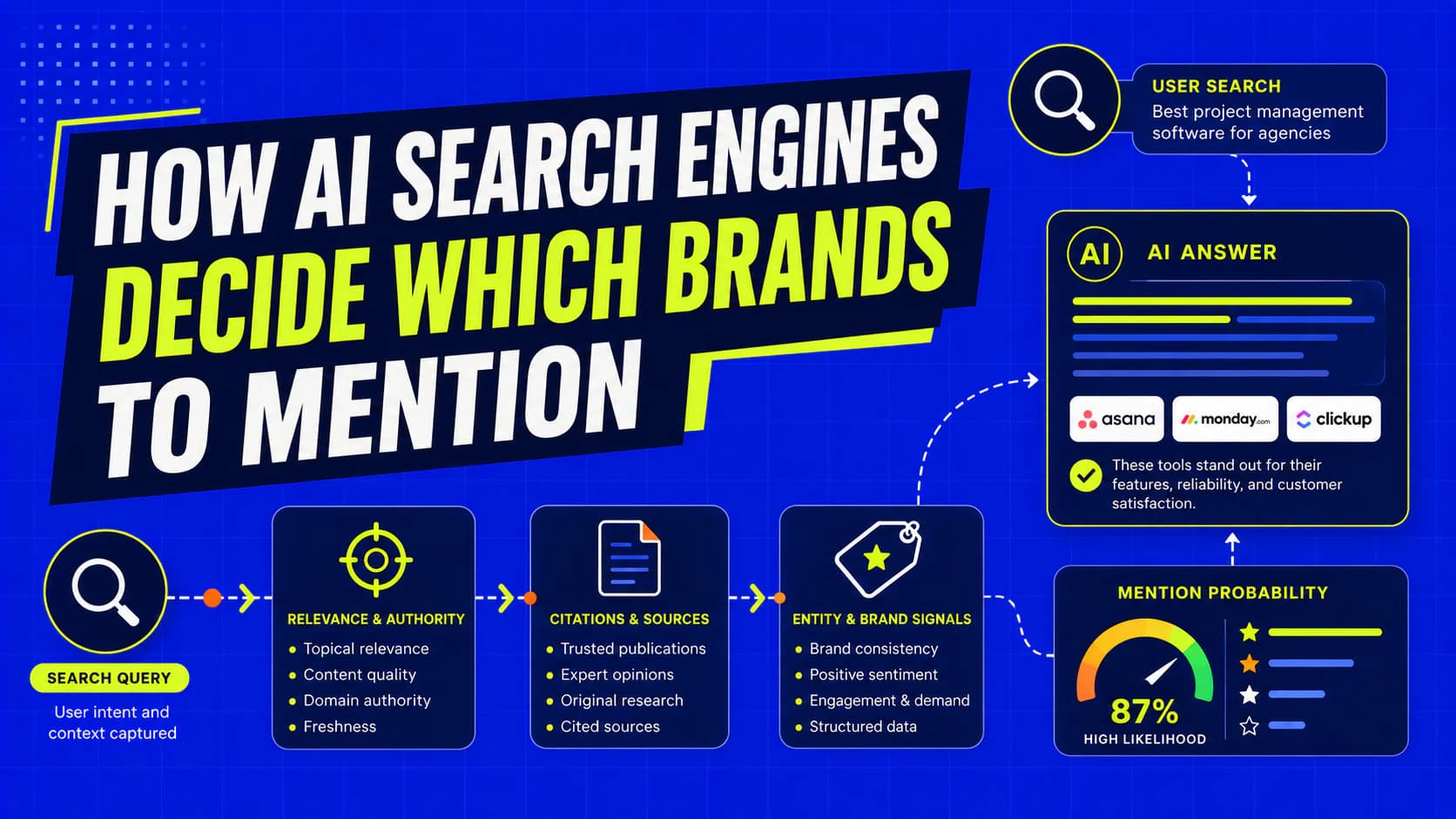
How AI Search Engines Decide Which Brands to Mention
When a buyer asks an AI search engine, “What are the best tools for reducing SaaS churn?” the system rarely starts with a clean list of every company in the market and scores them one by one.
That is the wrong mental model.
In practice, brand selection happens through a chain of smaller decisions: what sources are retrievable, which entities are clearly understood, which pages appear relevant to the exact question, whether claims are corroborated elsewhere, and whether the brand can be inserted into an answer with enough confidence to be useful.
This is why a company with excellent products can remain almost invisible in AI answers while a smaller competitor appears repeatedly.
The difference is often not “brand authority” in the traditional sense. It is answerability: how easy the web makes it for an AI system to understand what you do, verify it, connect you to a specific use case, and confidently mention you in context.
A practical way to diagnose AI visibility is to treat brand mentions as the result of five conditions:
Retrievable + Relevant + Understood + Corroborated + Easy to Cite.
Miss one of those badly enough and the probability of being mentioned drops quickly.
AI Search Is Not Just a New Ranking Page
Traditional search conditioned marketers to think in positions: rank #1, rank #4, page two.
AI search behaves differently. The user may receive a synthesized answer containing three brands, a short explanation of who each is best for, and a few supporting citations. The system is not merely deciding which URL should sit above another URL. It is deciding which facts and entities deserve to become part of the final response.
That distinction matters.
A page can rank reasonably well in Google and still contribute almost nothing to an AI-generated answer. Conversely, a brand can occasionally be mentioned because a highly relevant third-party source describes it well, even if the company’s own page is not the strongest result.
The systems also differ. ChatGPT, Gemini, Perplexity, Google AI experiences, and other answer engines do not use identical retrieval pipelines or source-selection logic. You should not pretend there is one universal “AI ranking algorithm.”
But across platforms, the same practical question keeps appearing:
Does the available evidence make this brand a safe and useful inclusion for this specific answer?
That is the question your visibility strategy should be built around.
1. The Brand Has to Enter the Retrieval Set First
Before an AI system can mention you, it needs some path to retrieve information about you.
This sounds obvious, but it explains a large percentage of visibility problems.
Many companies start by rewriting homepage copy for “AI optimization” while ignoring basic discoverability. Important pages are weakly indexed, JavaScript-dependent, buried in poor internal linking, duplicated across routes, blocked accidentally, or written so vaguely that search systems cannot determine when they are relevant.
This is where SEO remains foundational to AEO.
If search engines cannot efficiently crawl, index, interpret, and rank your content for relevant concepts, AI retrieval will often inherit the same weakness. AEO does not replace technical SEO, information architecture, internal links, semantic relevance, or useful content. It builds on them.
For a SaaS company, I normally check whether there are strong, indexable pages for:
- Core product category
- Primary use cases
- High-value industries
- Major integrations
- Alternatives and comparisons
- Problems the product solves
- Relevant buyer questions
A single polished homepage is not enough. AI systems need multiple retrieval entry points that connect your brand to the language buyers actually use.
2. The System Needs to Understand Exactly What Your Brand Is
A common visibility problem is not lack of content. It is entity ambiguity.
Suppose your homepage says:
“Transform the way modern teams unlock operational excellence.”
That might sound acceptable in a pitch deck. It is terrible evidence for a system trying to answer, “Which customer success platforms help B2B SaaS teams identify churn risk?”
AI systems benefit from explicit relationships:
Brand → category → audience → capability → use case.
For example:
“Acme is a customer success platform for B2B SaaS teams that combines health scoring, product usage signals, renewal workflows, and churn-risk alerts.”
That sentence is less poetic and dramatically more useful.
Entity clarity should be consistent across your website, software directories, company profiles, review platforms, press mentions, partner pages, founder bios, and relevant industry coverage. If one source calls you an “AI operations platform,” another calls you “workflow software,” and your website never names a recognizable category, the system has to resolve unnecessary ambiguity.
Good AEO work often looks surprisingly unglamorous: tightening definitions, making categories explicit, cleaning inconsistent descriptions, and ensuring the same product concepts appear across trusted sources.
3. Mentions Are Decided at the Query Level, Not the Brand Level
Brands frequently ask, “Why does ChatGPT not mention us?”
The better question is: For which prompts should it mention you?
AI visibility is rarely binary.
A project-management product might be a legitimate candidate for:
- Best project management tools for agencies
- Project management software with client portals
- Asana alternatives for small teams
- Tools for managing creative approval workflows
But it may be a weak fit for:
- Best enterprise portfolio management platforms
- Construction project management software
- Free personal task-management apps
The same brand can be highly mentionable for one prompt cluster and irrelevant for another.
This is why broad visibility tracking can mislead teams. Tracking only “best project management software” may tell you very little about where actual buyers discover products.
Map prompts by decision context:
- Category discovery
- Problem discovery
- Comparison
- Alternatives
- Use case
- Industry
- Feature requirement
- Company size
- Migration intent
- Pricing or budget constraint
Then we evaluate visibility within each cluster.
The goal is not to force the brand into every answer. It is to become one of the most defensible mentions where the product genuinely fits.
4. AI Systems Prefer Claims They Can Corroborate
Your website is an important source, but it is also obviously self-interested.
If your site says, “We are the best analytics platform for startups,” that statement has almost no independent evidentiary value.
If your site explains that you offer warehouse-native product analytics, several customer case studies confirm the use case, software directories place you in the same category, integration partners describe the product similarly, and reputable articles mention you alongside comparable platforms, the claim becomes much easier to trust.
This is why corroboration matters so much.
The strongest brand footprints usually have agreement between first-party and third-party sources.
Think of it as a distributed evidence graph. Your website says what you are. Other credible pages confirm that you are actually perceived that way.
Useful corroboration may come from:
- Customer case studies
- Review sites
- Software marketplaces
- Integration directories
- Partner pages
- Industry publications
- Expert roundups
- Podcasts with transcripts
- Conference pages
- Public documentation
- Community discussions
The objective is not to manufacture hundreds of low-quality mentions. Ten precise, credible, topically relevant references can be more useful than a thousand generic directory listings.
5. The Brand Must Fit Naturally Inside the Answer
AI systems are generating prose, not simply returning blue links. A brand becomes more useful when the system can explain why it belongs in the answer.
Compare these two information footprints.
Brand A is described everywhere as:
“An innovative AI-powered platform built for the future of work.”
Brand B is consistently described as:
“A meeting assistant for sales teams that records calls, creates CRM-ready summaries, and surfaces coaching insights.”
If the question is “What tools can automatically summarize sales calls and push notes to a CRM?”, Brand B is easier to mention because its role in the answer is obvious.
This is why practical specificity beats generic positioning.
Your pages should make it easy to extract statements such as:
- Best suited for whom
- What problem it solves
- What differentiates it
- What it integrates with
- What limitations exist
- What pricing model it uses
- When a competitor may be a better fit
Even limitations can help. A page that says, “This plan is designed for teams above 20 users; very small teams may prefer a lighter tool,” provides clearer decision support than claiming the product fits everyone.
AI answers are often comparative. Useful decision criteria give the system better material to work with.
6. Category Association Matters More Than Repeating Your Brand Name
One mistake I see repeatedly is excessive branded content with weak category coverage.
Companies publish announcements, founder updates, feature launches, culture posts, and company news. Search engines can find the brand name everywhere, yet still have limited evidence connecting the brand to important commercial concepts.
If you want to be mentioned for “AI customer support software,” your web footprint should repeatedly and naturally establish relationships with concepts around that category:
customer support automation, ticket resolution, help desk workflows, agent assist, knowledge bases, response generation, escalation, QA, and support analytics.
This does not mean stuffing keywords into pages.
It means building a coherent topical footprint.
The strongest sites usually have a clear hierarchy:
Category page → use-case pages → feature pages → comparison pages → educational resources → proof.
Each page reinforces the same entity relationships from a different angle.
Over time, the brand stops being merely a named company and becomes strongly associated with a recognizable solution space.
7. Third-Party Context Can Decide Who Gets Mentioned
For many commercial prompts, the deciding evidence does not live on a vendor website.
Consider a query such as, “What are good HubSpot alternatives for early-stage SaaS companies?”
A system may retrieve comparison articles, Reddit discussions, review platforms, marketplace profiles, agency posts, and product pages. If several independent sources repeatedly place the same companies in the “HubSpot alternatives” set, those brands have an advantage.
This creates an important AEO principle:
You do not control your visibility only through your own domain.
Your off-site representation matters.
For established companies, this means auditing how the market describes the brand. For newer companies, it means earning presence in places that define the category.
Do not reduce this to backlink acquisition. A mention can matter because it strengthens the association between your entity and a relevant topic, use case, comparison, or customer profile.
The best outreach therefore sounds less like “Can you link to us?” and more like “Is there a legitimate reason this brand should be included in this decision set?”
That produces better coverage and better evidence.
8. Evidence Density Usually Beats Content Volume
A 4,000-word article is not automatically more useful to an AI system than a 700-word page.
What matters is the amount of usable evidence inside it.
I think of this as evidence density: how much specific, verifiable, decision-relevant information exists per section.
Low-density copy:
“Our powerful platform helps modern businesses increase productivity with intelligent automation.”
High-density copy:
“The platform connects to Salesforce and HubSpot, records Zoom and Teams calls, generates structured summaries, and can write selected fields back to the CRM after each meeting.”
The second passage gives a system facts it can map to multiple questions.
On important pages, look for extractable information:
- Clear definitions
- Specific capabilities
- Supported integrations
- Product constraints
- Customer segments
- Numerical proof where legitimate
- Methodology
- Examples
- Comparison criteria
- Direct answers to likely questions
The objective is not robotic writing. It is removing ambiguity.
9. Freshness Matters, but Stability Matters Too
AI visibility teams sometimes become obsessed with publishing frequency.
Freshness matters when the information itself changes: pricing, product capabilities, integrations, market comparisons, regulations, or fast-moving technical topics.
But constant publishing does not compensate for weak foundational pages.
A stable, well-maintained comparison page that is updated when the market changes can be more useful than twenty shallow posts published every month.
Pay particular attention to pages containing facts that become dangerous when stale:
- Pricing
- Feature availability
- Product names
- Integrations
- Competitor comparisons
- Benchmarks
- Statistics
If an AI system encounters conflicting versions of the same fact across your own site, confidence declines.
Content maintenance is therefore part of AEO, not an editorial afterthought.
10. A Practical Model for Brand Mention Probability
A simple diagnostic model helps explain why one company is mentioned and another is not.
For any important prompt, score the brand from 0–5 across six dimensions:
- Retrievability — Can strong pages about the brand be found for this topic?
- Entity clarity — Is it obvious what the company and product are?
- Query fit — Does the product genuinely match the request?
- Evidence quality — Are the claims specific, current, and useful?
- Corroboration — Do credible third parties support the same associations?
- Citation readiness — Can a system easily extract a concise reason to mention the brand?
This is not meant to imitate a proprietary ranking formula. It is a diagnostic framework.
Its value is that it tells you what to fix.
If retrievability is weak, work on SEO and content architecture.
If entity clarity is weak, fix positioning and consistency.
If corroboration is weak, improve your off-site footprint.
If citation readiness is weak, rewrite important pages around concrete answers and decision criteria.
If query fit is weak, stop trying to win that prompt.
That last point saves companies a surprising amount of wasted effort.
11. How We Diagnose a Brand That Is Missing From AI Answers
When a competitor keeps appearing and your brand does not, publishing more articles should not be the first move.
Start with the answer environment.
First, collect a representative set of high-intent prompts. Test them across relevant AI search experiences, noting which brands appear, how they are described, and which sources support those mentions.
Then reverse-engineer the evidence.
For each frequently mentioned competitor, ask:
- Which pages connect them to this query?
- Which third-party sources repeat that connection?
- What wording makes their use case easy to understand?
- Are they present in comparison and alternative content?
- Do they have stronger category pages?
- Is their documentation more explicit?
- Are customers or reviewers describing them consistently?
Only after that do we compare the client’s footprint.
The gap is usually visible: better content, stronger off-site corroboration, clearer category association, or simply better product-query fit.
The diagnosis should determine the strategy—not the other way around.
What Companies Get Wrong About AI Visibility
Three misconceptions cause most wasted work.
First: “We just need to mention our keywords more.”
No. Repetition without stronger evidence rarely solves the underlying problem.
Second: “We need hundreds of AI-optimized articles.”
Usually not. A smaller set of commercially important pages, built around real buyer questions and supported by strong external signals, is often a better starting point.
Third: “SEO no longer matters because people are using AI.”
This is especially dangerous. Retrieval systems still depend heavily on discoverable, structured, authoritative web content. Strong technical SEO, useful pages, internal linking, crawlability, and search visibility remain important inputs into the broader ecosystem that AI systems use.
AEO should extend your search strategy, not dismantle it.
The Real Goal: Become the Easiest Brand to Justify
You cannot force an AI engine to mention your company.
What you can do is improve the evidence available when the system has to decide which brands deserve inclusion.
Make the company easy to retrieve. Make the category unmistakable. Connect the product to specific buyer problems. Publish pages with high evidence density. Keep facts current. Build credible third-party corroboration. Give comparison systems enough context to explain both strengths and fit.
The brands that win AI visibility will not necessarily produce the most content. They will create the clearest, most consistent, most verifiable footprint across the web.
That is the shift worth paying attention to.
Not “How do we rank inside AI?”
But:
“When an AI system needs a trustworthy example for this exact problem, have we made our brand one of the easiest correct answers?”