
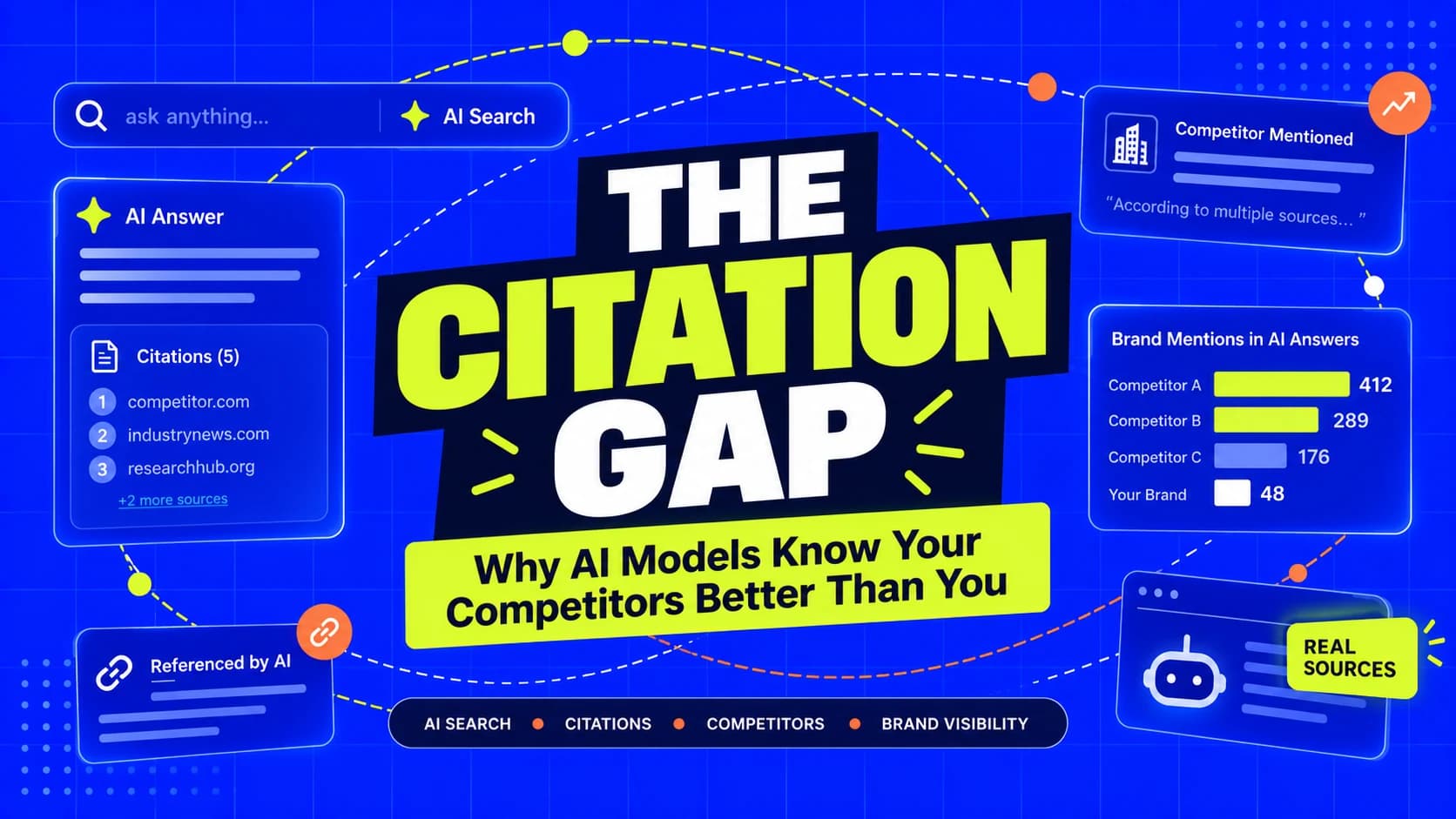
The Citation Gap: Why AI Models Know Your Competitors Better Than You
There is a frustrating pattern we see when auditing SaaS brands for AI visibility.
The company has a good product. Its website is technically sound. It may even rank well for several commercial keywords. Customers know the brand. The founder assumes ChatGPT, Perplexity, Gemini, and other AI search experiences must know it too.
Then we test real buyer questions.
“Best tools for X.”
“What software should I use for Y?”
“Alternatives to Competitor A.”
“Which platform is best for a 50-person team?”
The same competitors appear again and again. Your brand is missing, mentioned weakly, or excluded from the answer entirely.
That difference is the citation gap.
It is not simply a ranking problem. It is the gap between what is true about your company and what AI systems can confidently retrieve, verify, connect, and cite when constructing an answer.
And in practice, this gap explains a large percentage of AI visibility failures.
AI Does Not Need to “Like” Your Competitor
The first mistake is assuming an AI model has somehow decided that your competitor is the better company.
Usually, that is not what is happening.
Modern AI search experiences often combine language models with retrieval systems. When a user asks a current or commercial question, the system may search for supporting information, gather relevant pages, and use those sources to construct an answer.
That means your real competition is not only the competitor’s product.
You are competing against their evidence footprint.
One company may have:
- comparison pages explaining exactly who the product is for,
- documentation describing specific use cases,
- recent feature announcements,
- review-platform profiles,
- integration pages,
- customer stories,
- industry roundups,
- founder interviews,
- partner listings,
- third-party tutorials,
- consistent company descriptions across the web.
Another company may have a beautiful homepage, five generic blog posts, and very little external corroboration.
To a human who has used both products, the second company may be better.
To a retrieval system trying to support an answer with evidence, the first company is dramatically easier to understand.
That is the beginning of the citation gap.
The Difference Between Being Known and Being Citable
This distinction matters.
A model may have encountered your brand somewhere in its training data. That does not mean the brand will be selected when a current answer needs supporting sources.
Think of AI visibility as three separate layers.
1. Entity recognition
Can the system identify who you are?
Does it understand your company name, product category, website, and the basic relationship between your brand and the problem you solve?
2. Retrieval relevance
When a user asks a specific question, does your content appear relevant enough to retrieve?
A page saying “The operating system for modern teams” may sound good to prospects but provides very little direct evidence for a query such as “best SOC 2 automation software for an early-stage SaaS company.”
3. Citation confidence
Even if your page is retrieved, is there enough precise, credible information for the system to use it as support?
This is where many brands lose.
Their content contains claims, but not enough evidence.
Their positioning is broad, while the query is narrow.
Their website says one thing, review platforms say another, and third-party pages use outdated descriptions.
The result is uncertainty.
AI systems tend to perform better when they can connect multiple clear signals. Your competitor wins because the web has made their story easier to verify.
Why the Citation Gap Forms
After reviewing AI visibility problems, we usually find that the gap is not caused by one missing optimization. It is the accumulated effect of several small weaknesses.
Your website is optimized for persuasion, not retrieval
Most SaaS websites are built to convert humans.
That is correct. They should be.
But conversion copy frequently removes the details retrieval systems need.
Consider two descriptions.
“Turn customer conversations into growth.”
Versus:
“A conversation intelligence platform for B2B sales teams that records calls, generates transcripts, summarizes objections, and syncs notes to Salesforce.”
The first may make a strong hero line.
The second gives a machine far more information to work with.
You do not need to turn your website into robotic SEO copy. The solution is to keep the persuasive messaging while placing explicit factual language around it.
A model should not have to infer your category from three sections of brand language.
Your competitor has more query-shaped evidence
A common SaaS content strategy is to publish broad educational articles.
“What Is Revenue Operations?”
“The Future of Customer Support.”
“10 Trends Shaping Cybersecurity.”
These can support SEO and brand authority, but they do not necessarily answer the questions that cause products to be recommended.
AI recommendation prompts are often highly specific:
- best X for startups,
- X for regulated companies,
- X that integrates with Y,
- X versus Z,
- affordable X for small teams,
- X with a particular feature,
- alternatives to a known vendor.
Your competitor may have pages that directly address these situations.
You may have more content overall, yet less content that maps to decision-stage questions.
That is why content volume is a poor proxy for citation readiness.
Your claims exist only on your own domain
First-party content matters. In fact, brand-controlled sources can play a major role in AI answers.
But the strongest evidence footprint rarely lives on one domain alone.
Suppose your website says:
“Built for enterprise security teams.”
That is a claim.
Now suppose an industry publication describes the product as an enterprise security platform, a customer case study explains a deployment across 8,000 endpoints, a technology partner lists the integration, and several credible reviewers discuss the same capability.
The claim is no longer isolated.
It has become a pattern.
We call this corroboration density: the number and quality of independent sources that reinforce an important fact about your brand.
The higher the corroboration density around the questions buyers ask, the easier it becomes for an AI system to construct a defensible answer that includes you.
Your information is inconsistent
One of the least glamorous AEO problems is also one of the most expensive: inconsistency.
Your homepage says you serve “B2B teams.”
Your LinkedIn page says “enterprise organizations.”
A two-year-old directory calls you a “sales enablement tool.”
A review site categorizes you under “AI assistants.”
Your documentation uses the product name differently.
An old pricing article still describes a discontinued plan.
Humans can reconcile this mess. Machines may not.
Consistency does not mean repeating identical marketing copy everywhere. It means keeping important entity facts stable:
- what the company does,
- who it serves,
- product names,
- core capabilities,
- integrations,
- pricing model where public,
- company and founder information,
- category terminology.
If the external web cannot agree on what you are, you should not expect an answer engine to confidently recommend you.
Your strongest proof is trapped in weak formats
Another pattern: the company has excellent evidence, but almost none of it is searchable.
The best customer results are inside sales decks.
The founder has deep expertise, but only shares it on private calls.
Implementation knowledge lives inside onboarding documents.
Feature explanations are hidden in product UI.
Customer quotes appear inside images.
Benchmark data sits in a PDF no one links to.
The company knows a lot. The public web knows very little.
This is a major strategic disadvantage.
AEO is partly the discipline of converting private organizational knowledge into public, crawlable, attributable evidence without exposing anything confidential.
The brands that do this consistently become easier to cite over time.
The Five Layers of Citation Readiness
When we assess a SaaS company, we do not start by asking, “How many times does ChatGPT mention us?”
We start by examining the infrastructure underneath that outcome.
Layer 1: Crawlability
Can search and AI crawlers access the pages that matter?
This sounds obvious, but crawler blocks, JavaScript rendering problems, CDN rules, accidental noindex tags, weak internal linking, and orphaned content still create unnecessary visibility problems.
This is also why AEO should not be framed as a replacement for SEO.
Strong technical SEO creates much of the retrieval foundation AI search depends on. Google explicitly states that its existing SEO fundamentals remain relevant to its generative AI search features, and OpenAI likewise tells publishers not to block its search crawler if they want page content included in ChatGPT search summaries and snippets.
If the evidence cannot be accessed, the rest of the strategy is irrelevant.
Layer 2: Entity clarity
Can a system quickly determine what your company is?
Your homepage, about page, product pages, structured data, profiles, and external references should reinforce a coherent identity.
You want important facts to be boringly obvious.
Ambiguity may feel sophisticated in branding. It is expensive in retrieval.
Layer 3: Query coverage
Do you have useful pages for the questions your buyers actually ask?
This includes informational queries, but also comparison, category, integration, use-case, objection, alternative, and recommendation queries.
For most SaaS companies, the biggest opportunity is not producing another 100 top-of-funnel articles.
It is filling the 20–40 high-value decision questions where competitors currently have better evidence.
Layer 4: Proof density
Does the page contain information worth citing?
A citation-ready page usually contains concrete material:
- definitions,
- specific capabilities,
- limitations,
- comparisons,
- steps,
- data,
- examples,
- implementation details,
- original observations,
- customer outcomes,
- named integrations,
- methodology.
Generic copy is hard to cite because it adds little informational value.
Experience is an advantage here. The observations your support, sales, engineering, and implementation teams consider “obvious” are often exactly what makes your content non-commodity.
Layer 5: External corroboration
Does the wider web confirm the important things you say about yourself?
This can come from customers, partners, directories, respected publications, podcasts, communities, analysts, integration ecosystems, conference pages, or independent reviewers.
The goal is not link building for the sake of link count.
The goal is to create a consistent evidence network around your brand.
How We Measure the Citation Gap
A useful AEO audit should produce more than screenshots of ChatGPT answers.
We use a query set that represents actual buyer behavior and score the brand against competitors.
Start with 30–100 prompts divided into intent clusters:
- category discovery,
- use-case recommendations,
- comparisons,
- alternatives,
- integrations,
- feature requirements,
- industry-specific needs,
- company evaluation questions.
Run them across the AI surfaces that matter to your audience.
Then track five metrics.
Mention share
In what percentage of relevant answers does your brand appear?
Citation share
When sources are shown, what percentage of relevant citations point to your domain or to credible pages discussing your brand?
Competitive overlap
Which competitors repeatedly appear when you do not?
This is often more useful than the raw visibility score because it reveals the brands occupying your missing territory.
Source overlap
Which domains are repeatedly used to support your competitors?
These sources tell you what the ecosystem considers useful evidence.
Do not immediately treat the list as a backlink target. First understand why those sources are being selected.
Query-class coverage
Where exactly are you absent?
A company may perform well for “best enterprise X” but disappear for “X for startups,” integrations, alternatives, and industry-specific prompts.
A single visibility percentage hides these differences.
The purpose of measurement is diagnosis.
You are trying to identify the shortest path from not considered to retrievable and defensible.
How to Close the Gap
The wrong response is to manufacture dozens of shallow pages containing the phrase “best software” and hope models start quoting them.
That creates noise, not authority.
A better approach is systematic.
Step 1: Build the evidence map
For every high-value query cluster, document:
- what the user is trying to decide,
- which competitors appear,
- which sources support them,
- which claims those sources make,
- what credible evidence your brand currently has,
- what evidence is missing.
This turns AEO from vague “AI optimization” into a normal strategic content problem.
Step 2: Fix the first-party truth layer
Make your own site the clearest source of truth about the company.
Improve core product pages before producing large amounts of new content.
Add precise category language, use cases, integrations, product capabilities, FAQs, comparison context, implementation details, and proof where appropriate.
Do not write for a robot.
Write so that a human — or a retrieval system — can answer a specific question without guessing.
Step 3: Publish evidence, not filler
Your highest-value new content should contain information competitors cannot easily reproduce.
Examples include:
- original benchmarks,
- anonymized operational data,
- implementation frameworks,
- failure patterns observed across customers,
- migration checklists,
- architecture explanations,
- realistic comparison criteria,
- first-hand testing,
- detailed case studies.
This is where practical experience becomes an SEO and AEO asset.
A veteran operator can describe the trade-offs a generic writer never sees.
Step 4: Increase corroboration
Identify the facts you most want associated with your brand, then strengthen their external support.
If integrations matter, make sure integration partners correctly describe you.
If a niche use case matters, earn coverage in publications and communities that serve that niche.
If customer outcomes matter, turn them into public case studies customers can validate.
If a category matters, check how respected directories and review platforms classify you.
This is digital PR with a more precise objective: make important brand facts independently verifiable.
Step 5: Refresh the evidence network
AI search is not a one-time indexing event.
Products change. Pricing changes. Competitors launch features. New pages become more useful. Old sources decay.
Review high-value query clusters regularly.
When visibility changes, do not immediately rewrite everything.
Ask what changed in the evidence set.
Did a competitor publish a stronger comparison page?
Did a third-party roundup update?
Did your page become stale?
Did an important source stop ranking or become inaccessible?
The answer is usually more actionable than “the AI changed.”
What Most Teams Get Wrong
The biggest mistake is chasing the output instead of improving the inputs.
They see a competitor cited in ChatGPT and ask, “How do we make ChatGPT cite us?”
A better question is:
What evidence would a system need to confidently include us in this answer?
That question produces better work.
It leads to clearer positioning.
Better product pages.
More useful content.
Stronger technical SEO.
Better documentation.
More credible third-party mentions.
More disciplined measurement.
And that is the important point: most durable AEO improvements are not tricks for manipulating a model.
They are improvements to how well your company is represented on the searchable web.
The Citation Gap Is a Strategic Warning
If AI systems consistently know your competitors better than they know you, treat it as information.
It means the digital evidence surrounding your company is weaker, less accessible, less specific, less current, or less corroborated than the evidence surrounding theirs.
That does not mean they have the better product.
But it does mean they currently have the easier product to explain.
As AI-mediated discovery becomes a larger part of software research, that difference matters.
The brands that win will not be the ones that publish the most AI-generated content or bolt “GEO” onto an old content calendar.
They will be the ones that deliberately build a public evidence layer around their expertise, product, customers, and category.
SEO gets that evidence discovered and indexed.
AEO makes it easier to retrieve, understand, and use in an answer.
Authority makes it believable.
And citations are simply the visible trace of that underlying system.
If your competitors keep appearing while you do not, do not start by blaming the model.
Audit the evidence.
That is usually where the gap begins.