
For years, search visibility followed a familiar model:
A user searches. A search engine ranks pages. The user clicks one.
That model still matters. But it is no longer the only way people discover information.
Today, users increasingly ask complete questions and receive synthesized answers directly from platforms such as Google AI Overviews and AI Mode, Microsoft Copilot, ChatGPT Search, and other AI-powered discovery experiences.
That changes the job of optimization.
Traditional Search Engine Optimization (SEO) asks:
How do we make this page rank higher?
Answer Engine Optimization (AEO) asks a different question:
How do we make our brand and content useful enough to become part of the answer?
The distinction sounds small. Strategically, it is significant.
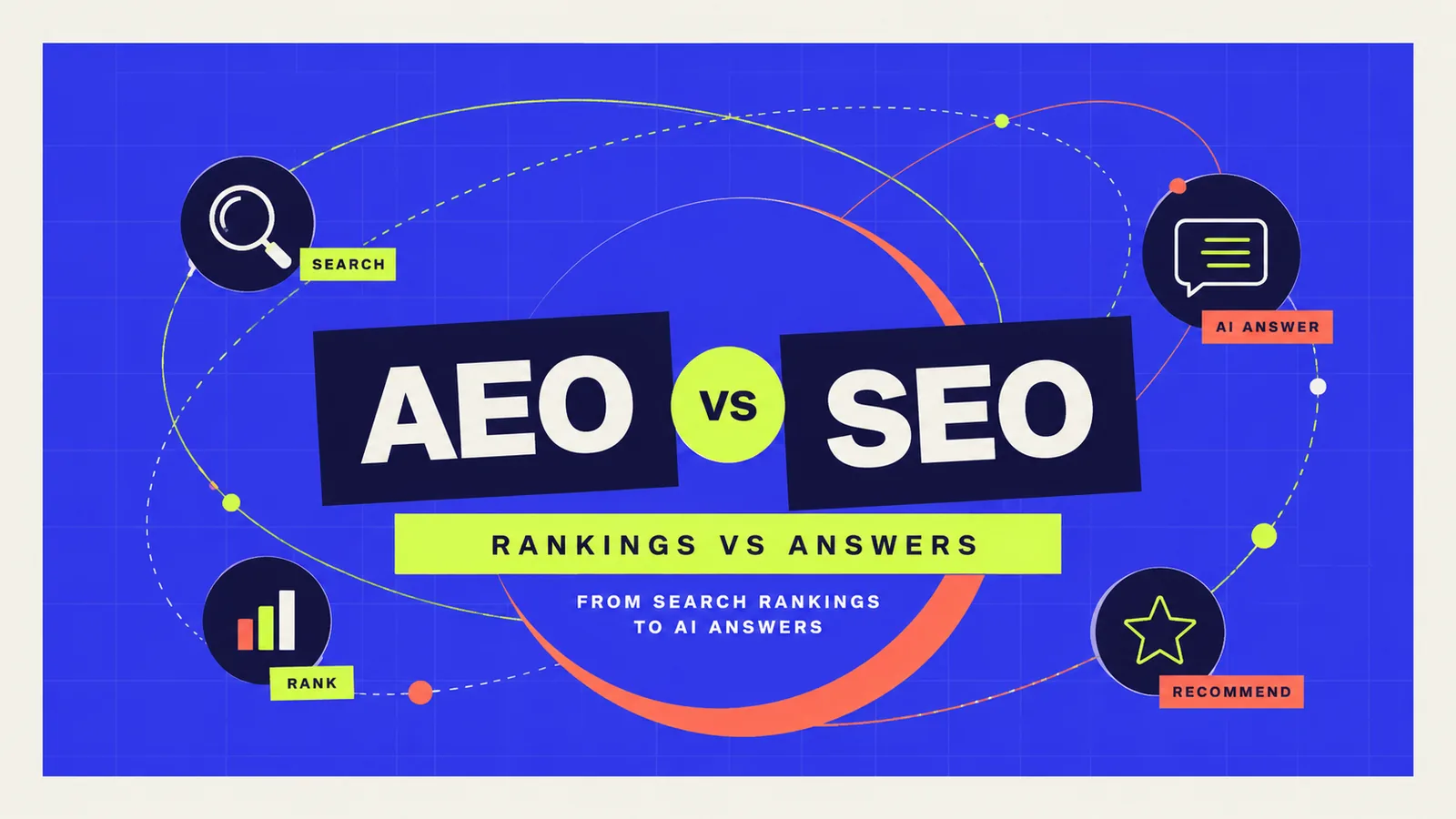
SEO is primarily about earning visibility in a ranked list of results. AEO is about earning selection, citation, recommendation, and representation inside generated answers.
And the companies that understand this early will have an advantage over those still measuring search visibility only through rankings and blue-link clicks.
What Is SEO?
Search Engine Optimization is the process of improving a website so search engines can crawl, understand, index, and rank its pages for relevant searches.
A strong SEO program typically focuses on areas such as:
- technical crawlability and indexability
- keyword and search-intent research
- site architecture
- internal linking
- content quality and topical coverage
- backlinks and authority
- page experience
- structured data
- on-page optimization
The objective is straightforward: when someone searches for something relevant to your business, your page should appear prominently enough to earn the click.
If you sell payroll software, for example, you might try to rank for searches such as:
- best payroll software for startups
- payroll software for small businesses
- how to automate payroll
- payroll software comparison
For traditional search, the page itself is usually the destination.
That assumption becomes less reliable in AI search.
What Is AEO?
Answer Engine Optimization is the practice of making your information easy for search engines and AI systems to understand, retrieve, trust, extract, and use when constructing an answer.
The desired outcome is not limited to ranking a URL.
Your goal may be to have your company:
- cited as a source
- mentioned as a solution
- included in a comparison
- used to support a factual claim
- recommended for a particular use case
- surfaced when a buyer asks a detailed question
- represented accurately when an AI system explains your category
This creates a different optimization problem.
Imagine a founder asks:
"What is the best payroll software for a 30-person remote startup that hires contractors in multiple countries?"
In a traditional search journey, that query might produce ten links.
In an AI-mediated journey, the system may research several sources, compare options, summarize trade-offs, and present a short list inside one answer.
The winner is no longer necessarily the company with the page sitting at position #1 for the broadest keyword.
It may be the company whose information is easiest to verify and most relevant to the exact question being answered.
That is the core shift from SEO to AEO.
AEO vs SEO: The Simplest Difference
Here is the distinction we use when thinking about the two disciplines:
SEO optimizes for retrieval and ranking.
AEO optimizes for retrieval, understanding, and answer inclusion.
They are not opposing strategies.
AEO sits on top of many SEO fundamentals.
A website that cannot be crawled, has weak content, lacks authority, or provides confusing information is unlikely to perform consistently in either traditional or AI-powered search.
But strong SEO alone does not automatically mean strong AEO.
You can rank well and still be difficult for an answer engine to use.
AEO vs SEO at a Glance
| SEO | AEO |
|---|---|
| Optimizes for search rankings | Optimizes for answer inclusion |
| Primary unit is often the webpage | Useful unit may be a passage, claim, fact, table, entity, or page |
| Success often means impressions, rankings, clicks, and conversions | Success may include citations, mentions, recommendations, answer visibility, referral traffic, and conversions |
| Targets keywords and search intent | Targets questions, entities, tasks, comparisons, and conversational intent |
| Tries to win a position | Tries to become a trusted source for an answer |
| Content is written to satisfy the searcher after the click | Content should also be understandable before a click |
| Authority helps pages rank | Authority also helps systems decide which information is worth relying on |
The key word is also.
AEO does not remove the need for SEO. It expands what "search visibility" means.
The Search Result Is Becoming an Interface, Not Just a Directory
Traditional search engines functioned largely as navigation systems.
They helped users find pages that might contain an answer.
Generative search increasingly attempts to perform part of the research itself.
Instead of simply returning documents, an AI system can:
- interpret a complex question,
- break it into subtopics,
- retrieve information from multiple sources,
- compare or reconcile that information,
- generate a response,
- cite or link to supporting sources.
That means a company can influence a buyer's decision before the buyer ever lands on its website.
For brands, this creates both an opportunity and a risk.
The opportunity is obvious: your company can appear in conversations where you never ranked for one exact keyword.
The risk is equally important: if AI systems cannot clearly understand what you do, who you serve, how you are different, or whether claims about you are trustworthy, competitors may define the category instead.
SEO Targets Keywords. AEO Targets Questions and Decisions.
Keywords are still useful.
But conversational search exposes a much richer layer of intent.
Consider a company selling observability software.
A traditional SEO keyword might be:
"observability platform"
A buyer using an AI assistant might ask:
"Which observability platforms are suitable for a Kubernetes-heavy engineering team that wants predictable pricing and does not want to manage its own infrastructure?"
The second query contains several decision criteria:
- category: observability
- environment: Kubernetes-heavy
- preference: managed solution
- commercial concern: predictable pricing
- audience: engineering team
A generic "observability platform" landing page may not provide enough information for an AI system to confidently determine whether the product fits.
An AEO strategy therefore maps not only keywords, but also the questions buyers ask while evaluating a decision.
Examples include:
- What is this?
- How does it work?
- Who is it for?
- When should I use it?
- What is it better than?
- What are its limitations?
- How much does it cost?
- Does it integrate with X?
- Is it suitable for Y?
- What alternatives exist?
- How does option A compare with option B?
- What should I choose if my priority is Z?
These questions are not merely blog topics.
Collectively, they form the information model that answer engines can use to understand your business.
The Most Important AEO Principle: Make the Answer Easy to Extract
Many websites contain useful information but make it unnecessarily difficult to find.
A simple question is followed by 400 words of context.
A pricing explanation is hidden behind vague marketing copy.
The product category is never stated clearly.
Feature names are branded phrases that make sense internally but not to an unfamiliar reader.
Comparison pages refuse to acknowledge any situation in which the competitor could be a better choice.
This creates ambiguity.
AEO-friendly content does the opposite.
It gives the direct answer early and then earns the right to elaborate.
For example:
Weak
"Our next-generation platform empowers modern organizations to unlock unprecedented productivity through an intelligent, integrated approach to collaboration."
Stronger
"Our platform is project-management software for product and engineering teams. It combines issue tracking, sprint planning, documentation, and team reporting in one workspace."
The second version is less clever.
It is also dramatically easier for a human, search engine, or language model to understand.
Clarity is not basic copywriting anymore.
It is part of your discoverability infrastructure.
Authority Matters Differently in AI Search
A common AEO misconception is that adding an FAQ section or schema markup will suddenly make a company appear in AI answers.
It will not.
Answer engines still need reasons to trust the information they retrieve.
That means authority remains critical.
But authority should be thought about at several levels.
1. Domain authority
Does the broader web treat your site as a credible source?
2. Topical authority
Does your site consistently demonstrate depth in the subject it wants to be known for?
3. Entity authority
Is there enough consistent information across the web for systems to understand who your company is and what it does?
4. Claim authority
Can specific statements on your site be supported by evidence?
A strong claim might include:
- original research
- a methodology
- customer evidence
- first-party data
- expert authorship
- citations to primary sources
- clearly defined calculations
- verifiable product documentation
The easier a claim is to verify, the easier it is to trust.
That principle benefits both SEO and AEO.
Structured Data Helps — But It Is Not AEO
Structured data is useful because it gives machines explicit information about the content and entities on a page.
Depending on the website, relevant markup may include:
- Organization
- Article
- Product
- SoftwareApplication
- Person
- BreadcrumbList
- Event
- LocalBusiness
- other applicable Schema.org types
But schema is not a substitute for good content.
If the page itself is vague, unsupported, outdated, or unhelpful, wrapping it in structured data does not turn it into an authoritative source.
Think of structured data as machine-readable clarification, not a ranking or citation hack.
Use it to reduce ambiguity.
Do not use it as a replacement for substance.
Why SEO Still Matters for AEO
This is where some AEO advice goes wrong.
You will sometimes see claims that SEO is becoming irrelevant because users can get answers without clicking search results.
That conclusion ignores how answer systems obtain information.
AI-powered search still depends heavily on discovering, retrieving, interpreting, and evaluating web content.
Those are problems SEO has been solving for years.
Technical SEO still matters because your content needs to be accessible.
Internal linking still matters because it helps establish relationships between pages.
High-quality content still matters because weak information is not useful simply because an AI system can read it.
Authority still matters because answer engines need to decide which sources deserve confidence.
Search intent still matters because relevance has not disappeared.
In fact, Google explicitly advises site owners that the same foundational SEO best practices remain relevant to its AI search experiences.
So the right question is not:
"Should we do SEO or AEO?"
The better question is:
"How do we evolve our SEO system so it performs in both ranked and generated search experiences?"
What Actually Changes When You Add AEO to SEO?
For most companies, the change should happen in how they research, structure, write, distribute, and measure content.
1. Move from keyword maps to question maps
Do not stop tracking keywords.
Add the real questions customers ask around each topic.
For every important product or category, map:
- educational questions
- problem-aware questions
- solution-aware questions
- comparison questions
- implementation questions
- pricing questions
- risk and objection questions
- use-case questions
This gives you a much more realistic picture of how people research with AI.
2. Write passages that can stand on their own
Important information should not require an entire page of context to understand.
Definitions, comparisons, recommendations, limitations, and factual claims should be concise and explicit.
A strong paragraph should often make sense even when retrieved independently from the rest of the page.
3. Build stronger entity signals
Use consistent names and descriptions for:
- your company
- products
- founders and experts
- categories
- features
- customer segments
- integrations
- locations
If one page calls your product an "AI workflow platform," another calls it a "business automation suite," and external profiles describe it as "project management software," machines receive conflicting signals.
Consistency helps reduce uncertainty.
4. Publish evidence, not just opinions
Original information is difficult to commoditize.
Examples include:
- benchmarks
- customer data
- industry surveys
- experiments
- proprietary frameworks
- implementation studies
- expert commentary
- transparent comparisons
A thousand sites can rewrite the definition of AEO.
Far fewer can publish a dataset showing which page characteristics correlate with AI citations in a specific industry.
That difference matters.
5. Improve commercial information
A surprising amount of AEO opportunity sits close to the buying decision.
Make it easy to understand:
- who the product is for
- who it is not for
- pricing model
- integrations
- deployment options
- security capabilities
- limitations
- migration requirements
- use cases
- alternatives
- differentiators
If this information is missing, an answer engine may rely on third-party descriptions of your product instead.
6. Refresh important content
AI systems do not benefit from confidently stated information that became wrong two years ago.
Pages discussing pricing, product capabilities, regulations, statistics, competitive comparisons, or rapidly changing markets need active maintenance.
Freshness should be intentional, not cosmetic.
Changing the publication date without updating the substance is not a strategy.
A Practical Example: SaaS Comparison Content
Suppose a SaaS company wants to appear when users ask:
"HubSpot vs Salesforce for a 50-person B2B SaaS company — which should we choose?"
A weak SEO approach might publish a 3,000-word article targeting the keyword "HubSpot vs Salesforce."
A stronger SEO + AEO approach would make the decision structure explicit:
HubSpot vs Salesforce: Quick Answer
Explain in two or three sentences which platform generally fits which type of company.
Best for Small Teams
State the criteria and why.
Best for Complex Enterprise Sales
State the criteria and why.
Pricing Model
Explain how the models differ.
Implementation Complexity
Explain expected operational differences.
Customization
Compare flexibility.
Reporting
Compare the relevant capabilities.
When HubSpot Is the Better Choice
Be specific.
When Salesforce Is the Better Choice
Be equally specific.
Decision Table
Summarize the trade-offs in a structured format.
Methodology and Sources
Explain how the comparison was created and when it was last verified.
Notice what changed.
The content is not merely "optimized for AI."
It is simply more explicit, useful, balanced, and verifiable.
That is why good AEO often looks like good information architecture.
How Should AEO Be Measured?
This is one of the biggest operational differences.
Traditional SEO teams are accustomed to metrics such as:
- organic impressions
- rankings
- click-through rate
- organic sessions
- conversions
- backlinks
Those metrics should remain.
But they no longer tell the entire story.
AEO measurement should gradually include:
- AI citation frequency
- brand mention frequency
- cited URLs
- prompts or topics where the brand appears
- competitor citation share
- sentiment and accuracy of brand representation
- AI-referred sessions
- conversions from AI referrals
- visibility across important buyer questions
This area is becoming more measurable.
Microsoft introduced AI citation reporting in Bing Webmaster Tools, while Google has introduced dedicated reporting for visibility in generative AI search experiences.
That is an important signal for marketing teams:
AI visibility is moving from an experimental concept toward a measurable acquisition channel.
Does AEO Mean Optimizing for ChatGPT?
No.
Reducing AEO to "how to rank in ChatGPT" is too narrow.
The underlying behavior is larger than any one platform.
Users are increasingly interacting with search systems through questions, follow-ups, comparisons, and generated responses.
The specific products will change.
The strategic requirement is more durable:
Make your brand's information discoverable, understandable, credible, and useful wherever machines mediate a buying decision.
That includes traditional search engines with generative features as well as standalone AI assistants with web search capabilities.
For example, OpenAI documents a dedicated search crawler, OAI-SearchBot, that can surface public websites in ChatGPT search experiences. Blocking the systems you want visibility from is therefore a technical AEO issue, just as blocking Googlebot would be an SEO issue.
AEO has technical foundations, not just content tactics.
The Biggest Mistake: Creating "AI Content" for AI Search
If your AEO strategy is:
- generate hundreds of articles with AI,
- add FAQs,
- add schema,
- mention every possible question,
you do not have an AEO strategy.
You have a content-volume strategy.
Answer engines have little reason to prefer the 500th rewritten explanation of a topic over the original or most authoritative source.
The better opportunity is to create information that makes your site worth citing.
Ask:
- What do we know that competitors do not publish?
- What can we explain better than anyone else?
- What customer questions are poorly answered online?
- What proprietary data can we safely publish?
- Which claims can we prove?
- Where can our experts provide first-hand insight?
- Which comparisons can we make more transparent?
- What terminology in our category is unnecessarily confusing?
AEO rewards clarity.
Authority comes from having something worth saying.
AEO Is Not Replacing SEO. It Is Expanding the Search Surface.
The SEO industry has gone through many supposed "SEO is dead" moments.
This is not another one.
Search is changing, but the web is still a critical information layer underneath many AI experiences.
The practical shift is that discovery no longer happens only on a results page.
Your brand can now be discovered:
- in a traditional organic result
- inside an AI Overview
- inside AI Mode
- in an AI-generated comparison
- as a cited source
- in a recommendation
- during a follow-up question
- through an AI assistant's web search
So optimization has to account for more than rankings.
The future search team will likely think less in terms of "SEO content" and more in terms of information visibility.
They will ask:
Can machines access our information?
Can they understand it?
Can they verify it?
Do they associate us with the topics we want to own?
Do they retrieve us for the questions that matter?
Do they represent our product accurately?
And when a buyer asks for a recommendation, are we part of the answer?
That is AEO.
SEO Gets You Found. AEO Helps You Get Chosen.
A useful way to think about the relationship is:
SEO builds the foundation for discoverability.
AEO extends that foundation into generated answers and AI-mediated decisions.
If your company already invests in SEO, do not tear down the system.
Evolve it.
Keep the technical discipline.
Keep building authority.
Keep understanding search intent.
But add a new layer:
- question-level research
- answer-first content
- clear entity information
- extractable passages
- verifiable claims
- original evidence
- transparent comparisons
- AI visibility measurement
Because the goal of search optimization is changing.
It is no longer enough to be one of the pages an engine can rank.
Increasingly, you need to become one of the sources it is willing to trust, use, and cite.
And that is the real difference between SEO and AEO.
Sources & Further Reading
- Google Search Central: AI features and your website
- Google Search Central: Generative AI optimization guidance
- Google Search Central: Creating helpful, reliable, people-first content
- Google Search Central: Introduction to structured data
- Microsoft Bing: AI Performance in Bing Webmaster Tools
- OpenAI: Overview of OpenAI crawlers