
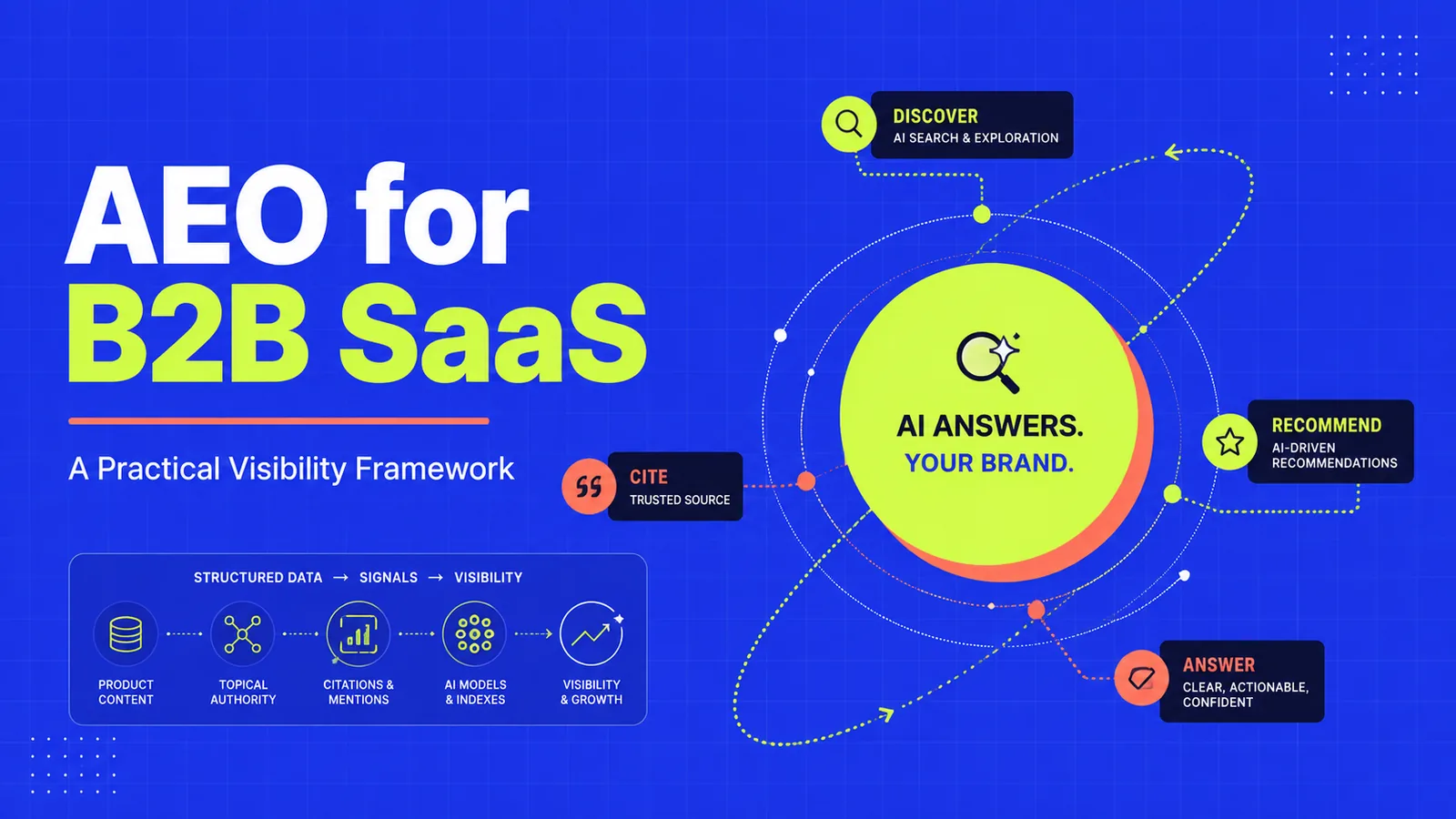
AEO for B2B SaaS: A Practical Visibility Framework
For years, SaaS search strategy was built around a familiar sequence:
rank → earn the click → move the visitor through the funnel.
Answer engines change the sequence.
A buyer can now ask ChatGPT, Google AI Mode, Copilot, or another AI assistant:
- “What is the best customer success platform for a 100-person SaaS company?”
- “Which SOC 2 compliant analytics tools work with Snowflake?”
- “What are the strongest alternatives to Product X for European teams?”
- “Compare Product A and Product B for an enterprise procurement team.”
- “What should I use if I need SSO, audit logs, Salesforce sync, and EU data residency?”
The buyer may receive a synthesized shortlist before visiting a single vendor website.
That is the strategic change.
For a B2B SaaS company, Answer Engine Optimization is the discipline of increasing the probability that your company is correctly understood, retrieved, cited, and recommended when an AI system answers commercially relevant questions.
The last two words matter: commercially relevant.
A SaaS company can accumulate thousands of AI mentions and still create almost no pipeline. Visibility around “what is project management?” is very different from visibility around “best project management software for a 40-person architecture firm with resource planning.”
The goal is not to become visible everywhere.
The goal is to become visible where buying decisions are being formed.
This article lays out the framework we use to think about that problem in practice.
AEO is not a replacement for SEO
One of the easiest ways to waste an AEO program is to treat AI search as an entirely separate universe.
It is not.
Google's own guidance is explicit that its generative search experiences still depend heavily on the same foundational search systems that determine whether content is accessible, useful, trustworthy, and relevant. OpenAI similarly separates its search crawler from its training crawler and requires sites to allow OAI-SearchBot if they want pages to be eligible to surface in ChatGPT Search. Microsoft has gone a step further by exposing AI citation activity inside Bing Webmaster Tools.
The practical implication is simple:
AEO sits on top of good technical SEO, strong information architecture, useful content, clear product positioning, and credible third-party evidence.
If those foundations are weak, “AI optimization” tactics rarely rescue the site.
We prefer to think of the relationship this way:
SEO helps machines find and rank your information. AEO helps machines confidently use your information inside an answer.
There is overlap, but the optimization target is different.
Traditional SEO asks:
“Can this page rank for the query?”
AEO adds several harder questions:
“Can a model understand the claim?”
“Can it extract the relevant passage?”
“Does it have enough confidence to cite it?”
“Does the rest of the web support or contradict it?”
“Does the answer make the product a credible candidate?”
That is a much better starting point for B2B SaaS.
The B2B SaaS visibility ladder
Before optimizing anything, separate the different levels of AI visibility.
They are not the same outcome.
1. Mentioned
Your brand appears somewhere in an answer.
Useful, but weak on its own.
2. Understood
The engine correctly understands what your product is, who it is for, the category it belongs to, the problems it solves, and important constraints around it.
A surprising amount of SaaS visibility breaks here.
3. Retrieved
Your pages are selected as relevant source material for a buyer question.
4. Cited
The engine visibly references your site or content in the generated answer.
5. Shortlisted
The brand is not merely cited as background information; it is included as a plausible solution.
6. Preferred
The engine has enough evidence to explain why your product may be a better fit for a particular use case than alternatives.
7. Converted
The visibility creates a measurable commercial action: branded search, product page visit, signup, demo request, assisted opportunity, or revenue.
Most AEO reporting stops at level one or four.
B2B SaaS teams should care about levels five through seven.
The Practical B2B SaaS AEO Framework
We use six layers when diagnosing or building AI visibility for a SaaS company:
- Demand Mapping — identify the questions that influence revenue.
- Entity Clarity — make the product unambiguous to machines and buyers.
- Answer Assets — create pages that can supply complete, extractable answers.
- Evidence Density — give engines reasons to trust specific claims.
- Corroboration — make the rest of the web reinforce the same story.
- Measurement — track citation, recommendation, accuracy, and pipeline impact.
The order matters.
A company that starts by publishing 50 “AI-optimized” articles before fixing positioning usually scales confusion.
Layer 1: Demand Mapping — optimize around decisions, not keywords
The first mistake in AEO research is starting with a traditional keyword export.
Keywords are useful. But AI conversations are much more compositional.
A buyer combines requirements that previously would have been split across multiple searches.
For example:
“We are a Series B B2B SaaS company with 80 employees. We need a customer support platform that integrates with HubSpot, supports SSO, has strong reporting, and does not require a six-month implementation. What should we evaluate?”
There may be no meaningful monthly keyword volume for that exact sentence.
There is still enormous commercial intent inside it.
Build a buyer-question map
For most B2B SaaS companies, we map prompts into seven intent groups.
| Intent | Typical buyer question | Commercial value |
|---|---|---|
| Category education | “What is revenue intelligence software?” | Low to medium |
| Problem diagnosis | “How do SaaS teams reduce onboarding drop-off?” | Medium |
| Solution discovery | “Best tools for reducing onboarding drop-off” | High |
| Comparison | “Product A vs Product B for mid-market SaaS” | Very high |
| Alternatives | “Best alternatives to Product A” | Very high |
| Capability validation | “Does Product X support SAML SSO and SCIM?” | Very high |
| Implementation / risk | “How long does Product X take to implement?” | Very high |
The biggest mistake is over-investing in the first row because it has the most obvious search volume.
For pipeline, the lower rows often matter more.
Add buyer constraints
The real leverage comes from modifiers.
Map questions by:
- company size,
- industry,
- geography,
- technical stack,
- security requirements,
- compliance requirements,
- implementation complexity,
- pricing model,
- team maturity,
- primary use case,
- role of the evaluator.
A generic page for “best CRM” is difficult to own.
A genuinely useful page for “best CRM for a 20-person B2B sales team migrating from spreadsheets and needing HubSpot marketing integration” gives an answer engine much more context to work with.
Do not manufacture hundreds of near-duplicate pages for every modifier.
Instead, identify the combinations your real prospects repeatedly care about and build substantial assets around those.
Layer 2: Entity Clarity — make it impossible to misunderstand what you sell
A model cannot recommend a product confidently if it cannot describe the product confidently.
This sounds obvious. In practice, SaaS websites are full of ambiguity.
A homepage says:
“Transform how modern teams unlock intelligent growth.”
A product page says:
“The operating layer for high-performance organizations.”
The navigation says “Platform,” “Solutions,” and “Resources.”
After three pages, the visitor still cannot tell whether the company sells analytics software, consulting, workflow automation, or an AI assistant.
Machines have the same problem.
Your product should have a stable factual identity
Across your homepage, product pages, about page, documentation, schema, third-party profiles, review sites, partner directories, and founder descriptions, the following facts should remain consistent:
- What category are you in?
- What does the product actually do?
- Who is the primary user?
- What company type is it built for?
- Which problems does it solve?
- What are the major capabilities?
- Which platforms does it integrate with?
- What are the important limitations?
- Where is the company based?
- What is the relationship between company name and product name?
AEO is partly an entity consistency problem.
If your own website calls the product a “customer intelligence platform,” review sites classify it as “product analytics,” LinkedIn says “AI growth platform,” and your documentation describes a “data activation tool,” an answer engine has to reconcile those identities.
Do not make it work harder than necessary.
A simple test
Give a smart person five minutes on your site, then ask them to complete this sentence:
“[Product] is a __________ for __________ that helps them __________.”
If three people produce three materially different answers, fix positioning before scaling AEO content.
Layer 3: Answer Assets — build pages that can actually answer the question
A large percentage of SaaS content was written for a human who was expected to read the whole page.
Answer engines often work differently.
They need passages that can stand on their own.
That does not mean writing robotic 40-word chunks or stuffing every heading with a question. It means structuring important information so a relevant section contains enough context to be useful when retrieved independently.
The answer-unit pattern
For commercially important questions, a strong section usually contains five elements:
- Direct answer — answer the question immediately.
- Qualification — explain when the answer changes.
- Evidence — support the claim with facts, data, examples, or documentation.
- Contrast — explain what is different from common alternatives.
- Next decision — tell the reader what they should evaluate next.
For example, a weak integration section says:
“Powerful Salesforce integration. Connect your workflows seamlessly.”
A stronger answer asset says:
“Acme syncs accounts, contacts, opportunities, owners, and selected custom fields with Salesforce. Admins can configure one-way or two-way sync rules by object. Enterprise plans also support SSO and audit logs. Teams that only need a one-time CSV import do not need to enable the Salesforce integration.”
The second version is easier for a buyer to evaluate and easier for an answer engine to use.
The highest-value AEO assets for B2B SaaS
In most SaaS programs, we prioritize these before expanding the top-of-funnel blog:
Product and feature pages
These should contain concrete capability information, not just benefit copy.
Use-case pages
Tie the product to a specific workflow, team, or business problem.
Industry pages
Useful when requirements genuinely differ by industry. Avoid templated vertical pages with only the nouns swapped.
Integration pages
These are disproportionately valuable because buyers frequently ask AI systems whether tools work together.
Comparison pages
Write them like an informed evaluator, not a campaign landing page. State where each product is stronger.
Alternative pages
Explain the reason someone would switch, the trade-offs, migration considerations, and ideal fit.
Pricing and packaging explainers
Ambiguous pricing creates ambiguous answers. If exact pricing cannot be public, explain the pricing model, major variables, minimums, and what is included.
Documentation
For technical SaaS, documentation is often one of the richest sources of factual product truth on the entire domain.
Security and compliance pages
Security questions are common late-stage evaluation prompts. Do not bury them in a PDF nobody can crawl.
Case studies
A strong case study is not “Company X loved us.” It is structured evidence: context, previous process, implementation, measurable outcome, time period, and constraints.
Original research
Benchmarks, datasets, surveys, experiments, and operational analyses create information that other sites cannot simply rewrite from existing search results.
That last category is especially important.
Layer 4: Evidence Density — claims need proof
AEO programs become interesting when you stop asking, “How do we mention our product more?” and start asking:
“What evidence would make a neutral system comfortable repeating this claim?”
Consider these two statements:
“We are the fastest onboarding platform.”
and:
“Across 74 customers that went live in Q2, the median time from contract signature to first production workflow was 11 days. The measurement excludes customers that paused implementation for internal procurement or security review.”
The second statement is not merely more persuasive.
It is more citeable.
Build an evidence inventory
Every SaaS company has valuable evidence trapped inside the business.
Look for:
- product usage data,
- implementation timelines,
- customer benchmarks,
- anonymized performance distributions,
- win/loss themes,
- support ticket patterns,
- integration coverage,
- uptime history,
- security certifications,
- case-study outcomes,
- migration statistics,
- time-to-value data,
- internal research,
- expert commentary from people who do the work.
Then convert that evidence into public, understandable assets where confidentiality allows.
The veteran rule: specificity beats adjectives
When we review SaaS pages, we routinely remove words such as:
- seamless,
- powerful,
- revolutionary,
- intelligent,
- effortless,
- best-in-class,
- next-generation.
Then we ask the product team to replace them with facts.
“Seamless integration” becomes the objects synced, direction of sync, refresh frequency, permissions required, and known limitations.
“Enterprise-grade security” becomes SOC 2 Type II, SAML SSO, SCIM, encryption behavior, audit logs, data residency, retention controls, subprocessors, and the security review process.
“Fast implementation” becomes median implementation time by customer segment.
That work improves conversion even before it improves AEO.
Layer 5: Corroboration — your website cannot be the only source saying you are great
Answer engines synthesize information from multiple places.
That makes brand reputation and third-party consistency more important, not less.
If your website says you are built for enterprises but every public review describes you as an SMB tool, an AI system may trust the broader evidence more than your positioning page.
If your site claims a deep integration but the partner marketplace barely mentions you, confidence may be lower.
If you say your product is commonly used in healthcare but there are no healthcare case studies, implementation partners, reviews, conference talks, or industry references, the claim looks thin.
Useful corroboration sources include
- credible software review platforms,
- integration marketplaces,
- technology partner directories,
- customer websites,
- implementation partner sites,
- industry publications,
- analyst coverage,
- podcasts and webinars,
- GitHub repositories for developer products,
- public documentation,
- relevant community discussions,
- authentic customer comparisons.
The important word is authentic.
Do not turn AEO into a campaign for manufacturing low-quality brand mentions. Search systems have spent decades learning how to detect manipulative publishing behavior, and generative systems inherit much of that ecosystem.
The best corroboration strategy is still operational:
do something worth talking about, document it clearly, and make it easy for credible third parties to verify.
Layer 6: Technical Accessibility — let answer engines reach the useful material
You can have the best answer on the web and still be invisible if crawlers cannot access it.
For SaaS companies, technical problems commonly appear in four places.
1. JavaScript-heavy product pages
Important copy may render only after client-side execution or sit behind UI interactions that crawlers handle inconsistently.
Critical product facts should be available in accessible HTML.
2. Documentation hosted separately
Docs may live on a subdomain with different robots rules, canonical behavior, or weak internal links from the marketing site.
Treat documentation as part of the search and answer ecosystem, not as a support afterthought.
3. Accidental crawler blocking
Review robots.txt, CDN rules, bot protection, WAF behavior, and noindex directives.
If ChatGPT Search visibility matters, verify that OAI-SearchBot is not blocked. OpenAI documents this crawler separately from GPTBot, which is used for model-training controls.
4. Important information hidden behind forms
Security documents, implementation details, pricing guidance, integration matrices, and product specifications are often gated.
Gating may make sense for a sales process, but there is a trade-off: information that cannot be crawled cannot easily become source material for an answer engine.
A practical compromise is to publish a useful public summary and gate only the deeper asset.
What not to obsess over
Google currently says its generative search features do not require special “AI markup” or an llms.txt file. Structured data can still be useful where it accurately represents visible page content, but there is no universal magic schema that makes a SaaS brand an AI recommendation.
Do the boring technical work well:
- crawlable pages,
- clean canonicalization,
- sensible internal linking,
- descriptive titles and headings,
- fast, stable rendering,
- accurate structured data where relevant,
- current XML sitemaps,
- indexable documentation,
- clear relationships between company, product, authors, and content.
Boring infrastructure compounds.
The content strategy most SaaS companies get backwards
A common content program looks like this:
- publish 100 informational blog posts,
- hope domain authority rises,
- later build product and comparison pages.
For AEO, we often reverse the priority.
Start with the information an evaluator needs to decide whether your product belongs on the shortlist.
Then expand outward.
Tier 1: Product truth
Publish the definitive public version of:
- what the product does,
- who it is for,
- features,
- integrations,
- security,
- pricing model,
- implementation,
- limitations,
- deployment options.
Tier 2: Decision content
Create:
- comparisons,
- alternatives,
- buyer guides,
- migration guides,
- implementation guides,
- role-specific evaluations,
- industry-specific requirements.
Tier 3: Evidence content
Publish:
- benchmarks,
- customer studies,
- original datasets,
- surveys,
- experiments,
- product usage analyses,
- expert field notes.
Tier 4: Educational content
Expand into broader problem education and category demand.
This sequence tends to produce fewer pages with much higher commercial density.
A worked example: from keyword page to answer-engine asset
Imagine a SaaS company that sells resource planning software for agencies.
The traditional target might be:
Keyword: “resource planning software”
A conventional SEO page might contain category definitions, features, benefits, screenshots, and a CTA.
Useful, but incomplete for AEO.
Now look at the actual evaluation questions:
- What resource planning tools work well for 20–100 person agencies?
- Which tools combine capacity planning with project profitability?
- What is better for an agency: Product A, Product B, or spreadsheets?
- Which tools integrate with Xero and HubSpot?
- Which tools can forecast utilization six weeks ahead?
- Does this platform support contractors and part-time capacity?
- How long does migration from spreadsheets take?
- Can finance see projected revenue from scheduled work?
A stronger content system would include:
- a definitive resource planning category page,
- an “agency capacity planning” use-case page,
- integration pages for Xero and HubSpot,
- a migration-from-spreadsheets guide,
- competitor comparison pages,
- a profitability forecasting feature page,
- an implementation FAQ,
- a benchmark report on agency utilization,
- customer case studies segmented by agency size.
Now the domain can answer the network of questions surrounding the purchase, not just rank for one head term.
That is the shift.
How to measure AEO without fooling yourself
AEO measurement is still less mature than traditional rank tracking, so discipline matters.
Do not reduce the program to “we appeared in ChatGPT 37 times this month.”
Build a prompt portfolio tied to buyer intent.
Step 1: Create a fixed prompt set
Start with 50–100 commercially relevant prompts across:
- category discovery,
- use cases,
- alternatives,
- comparisons,
- capability validation,
- integration requirements,
- security,
- pricing,
- implementation,
- role-specific buying questions.
Do not change the set every week. You need a stable baseline.
Step 2: Track four visibility metrics
Citation share
For how many target prompts is your domain cited?
Recommendation share
For how many target prompts is your product actually recommended or shortlisted?
Entity accuracy
When the product is mentioned, are category, capabilities, pricing, target customer, integrations, and limitations described correctly?
Competitive position
Which competitors appear more often, and for which types of questions?
This is where the useful work starts.
If a competitor dominates “enterprise security” prompts but you dominate “ease of implementation,” the content gap is specific and actionable.
Step 3: Track downstream behavior
Monitor:
- referral traffic from AI products where identifiable,
- branded-search lift,
- direct traffic changes,
- demo-form self-reported attribution,
- “how did you hear about us?” responses,
- sales call mentions of ChatGPT / Gemini / Copilot / Perplexity,
- assisted opportunities,
- opportunity quality,
- revenue.
AI influence will often be under-attributed because the buyer may discover the product in an answer engine and later return through branded search or direct navigation.
Treat source-of-truth data as a mosaic, not a single analytics field.
Step 4: Use platform-native data where available
Bing Webmaster Tools now exposes AI Performance data for supported AI experiences, including citation activity and cited pages. Google has also introduced reporting for visibility in its generative search experiences through Search Console guidance and reporting features.
Use those datasets when available, but keep your own buyer-prompt tracking. Platform reports tell you what happened on their surfaces; your prompt portfolio tells you whether you are winning the questions that matter to your business.
A 90-day implementation plan
AEO becomes much easier when treated as an operating system rather than a campaign.
Here is a practical first 90 days.
Days 1–15: Diagnose
- Define your top three buyer segments.
- Build the initial commercial prompt portfolio.
- Record baseline visibility across the answer engines relevant to your buyers.
- Audit category and product descriptions across your site.
- Review robots, indexation, rendering, documentation access, and internal linking.
- Identify the competitors most frequently cited alongside or instead of you.
- List factual inaccuracies AI systems currently repeat about your product.
Deliverable: visibility baseline + entity gap report.
Days 16–30: Fix product truth
- Rewrite vague product descriptions.
- Strengthen product, feature, integration, pricing, security, and implementation pages.
- Make critical capability information explicit.
- Connect documentation and marketing pages through internal links.
- Correct inconsistent third-party profiles where you control them.
Deliverable: a clean, consistent product knowledge layer.
Days 31–60: Build decision assets
Prioritize the prompts closest to revenue.
Create or improve:
- comparison pages,
- alternative pages,
- integration pages,
- buyer guides,
- industry requirement pages,
- migration guides,
- implementation content.
Each page should answer a real buying question better than the generic material already available.
Deliverable: coverage of the highest-value evaluation journeys.
Days 61–90: Build the evidence moat
- Publish first-party benchmarks.
- Upgrade case studies with measurable outcomes.
- Turn internal subject-matter expertise into expert-led articles.
- Contribute genuinely useful insights to partner, industry, and community ecosystems.
- Re-run the fixed prompt portfolio.
- Compare citation, recommendation, and accuracy changes against baseline.
Deliverable: evidence that is difficult for competitors to copy.
Seven AEO mistakes we repeatedly see in B2B SaaS
1. Publishing AI-generated volume instead of new information
If the article is a rearrangement of the same ten pages already ranking, there is little reason for an answer engine to prefer it as a source.
Use AI to accelerate research and production if useful. But add information.
2. Optimizing only the blog
Your feature pages, docs, integrations, pricing, security center, customer stories, and help content may be more valuable to late-stage buyer questions than your blog.
3. Refusing to mention limitations
This feels counterintuitive, but specificity creates trust.
If your product is not ideal for a particular segment, say so.
Balanced comparison content is more useful than a page where your product mysteriously wins every category.
4. Treating every AI mention as a win
A citation in an informational answer is not equivalent to a recommendation in a buying answer.
Segment by commercial intent.
5. Obsessing over an llms.txt file while the website is unclear
Technical experiments are fine. They are not a substitute for strong product information, crawlability, evidence, or brand authority. Google specifically states that its generative Search features do not require llms.txt.
6. Hiding the strongest evidence inside sales decks
If your best benchmark, implementation data, ROI proof, and integration specifics exist only in decks used after the demo, the public web has a weak representation of the company.
Publish what you safely can.
7. Measuring only traffic
The buyer may never click the cited source during initial research.
Your real KPI may be increased shortlist inclusion, stronger branded demand, higher-intent direct visits, or prospects arriving at the demo already convinced you fit their requirements.
What “good” looks like
A mature B2B SaaS AEO program produces a web presence where:
- the product is described consistently across the web,
- important pages are technically accessible,
- buyer questions have direct, complete answers,
- commercial claims are backed by evidence,
- documentation confirms product capabilities,
- third-party sources reinforce the same positioning,
- comparisons acknowledge real trade-offs,
- the company publishes information competitors cannot easily reproduce,
- AI systems describe the product accurately,
- the brand appears more often in high-intent shortlists,
- sales and analytics teams can detect downstream commercial impact.
Notice what is missing from that list:
tricks.
AEO is becoming more technical to measure, but the strategic center is old-fashioned.
Be clear.
Be useful.
Be specific.
Be verifiable.
Be easier to trust than the alternatives.
The final framework
When evaluating any B2B SaaS page for answer-engine visibility, ask six questions:
1. Demand
Does this page answer a question that can influence a buying decision?
2. Clarity
Could a model correctly explain what we do after reading this page?
3. Extractability
Is the important answer stated clearly enough to be useful outside the full-page context?
4. Evidence
Have we provided enough proof for a neutral system to repeat the claim confidently?
5. Corroboration
Does credible information elsewhere on the web support the same story?
6. Commercial relevance
If we win visibility for this question, is there a plausible path to pipeline?
If the answer to two or three of those is “no,” publishing more content is usually not the solution.
Fix the information system first.
Because the real opportunity in AEO is not to make your SaaS company look popular to an AI.
It is to make your company the most defensible answer when your next customer asks what they should buy.
Practical AEO checklist for B2B SaaS teams
Before calling a page “AEO-ready,” verify that:
- The page targets a real buyer question or decision.
- The product/category relationship is explicit.
- Important claims are specific rather than adjective-heavy.
- Capabilities and limitations are both clear.
- The strongest answer appears before unnecessary narrative.
- Supporting evidence is visible on the page.
- Relevant product documentation is linked.
- The page is indexable and crawlable.
- Critical content is available in rendered HTML.
- Canonicals and internal links are correct.
- Third-party profiles do not contradict the page.
- The page adds information beyond what competitors already say.
- There is a clear next step for a qualified buyer.
- The target prompts are included in your recurring visibility benchmark.
AEO for B2B SaaS is still evolving, and the surfaces will keep changing.
The durable advantage is not guessing every new ranking factor.
It is building a public knowledge footprint that machines and humans reach the same conclusion from:
this company clearly understands the problem, can prove what its product does, and deserves to be considered.